VENUE REQUIREMENTS

ENSURING OUR Safety
& YOURS

Falling through the clouds can be the safest activity you could imagine, provided health and safety is in place and certain rules are followed.

Venue requirements

Not every venue is suitable for our team to display at, due to environmental factors outside of our control. As a guideline we set certain requirements in place to ensure the safety of all involved in our displays.

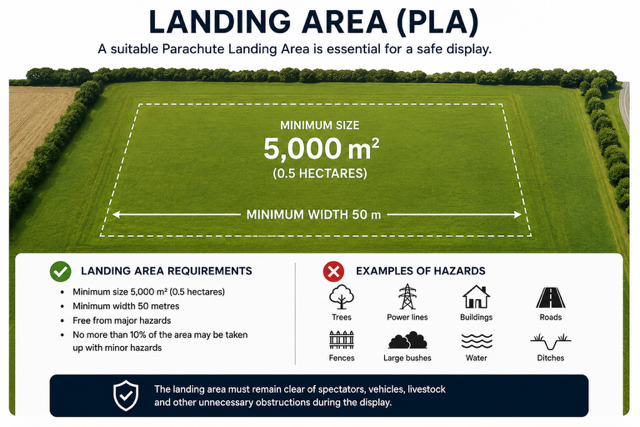
Minimum landing area dimensions

For most displays, we require a Parachute Landing Area (PLA) of at least 5,000 square metres, with a minimum width of 50 metres.

The landing area must be free from major hazards, with no more than 10% of the area occupied by minor hazards, and suitable overshoot areas must be available around the landing area.

Every proposed landing site will be assessed by the Skydive Tilstock Display Team before a display is confirmed.

The landing area must remain clear of spectators, vehicles, livestock and other unnecessary obstructions during the display.
Note: All Venues Must Be Clear of Overhead Hazards & Free From Spectators & Livestock

Aviation Permission Where Required 

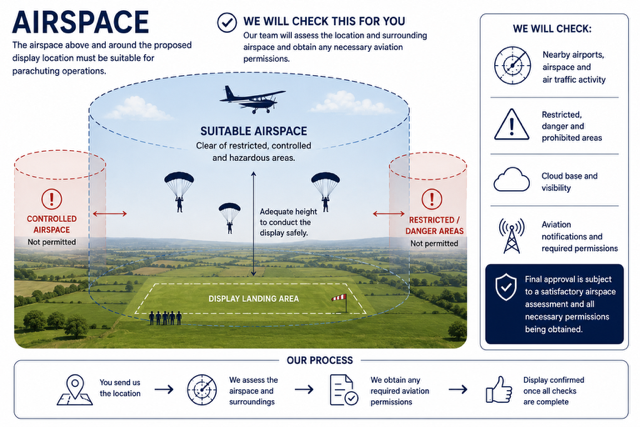
The airspace above and surrounding the proposed display location must be suitable for parachuting operations.

Don’t worry if you’re unsure about this – we will check it for you.

Our team can assess the location, surrounding controlled or restricted airspace and any aviation requirements associated with the display. Where required, we will coordinate the appropriate parachuting notification and aviation permissions.

Final approval of any display remains subject to satisfactory airspace assessment and the necessary permissions being obtained.
Safe and practical access to the landing area must be available for our Display Team ground crew and safety vehicle.

Access should remain available throughout the display so that our team can reach the landing area quickly should assistance be required.

Suitable access for the emergency services must also be maintained.

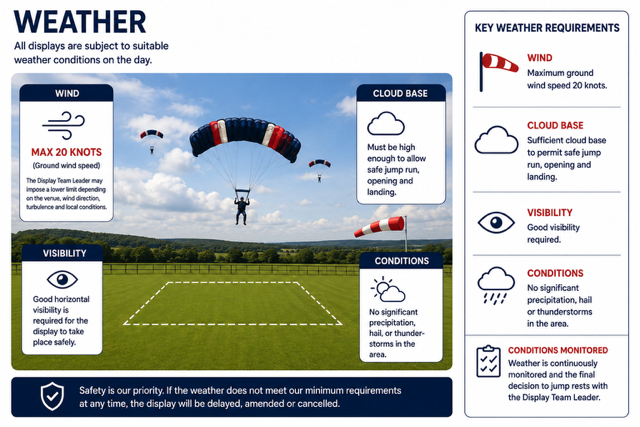
All displays are subject to suitable weather conditions on the day.

The maximum permitted ground wind speed for experienced British Skydiving licence holders is 20 knots. The Display Team Leader may impose a lower operational limit depending on the venue, wind direction, turbulence, landing area, surrounding hazards or other local conditions.

We also require suitable visibility and cloud base to allow the aircraft, parachutists and ground team to conduct the display safely and maintain the required visual conditions.

Weather conditions are continuously assessed and the final decision to jump rests with the Display Team Leader.
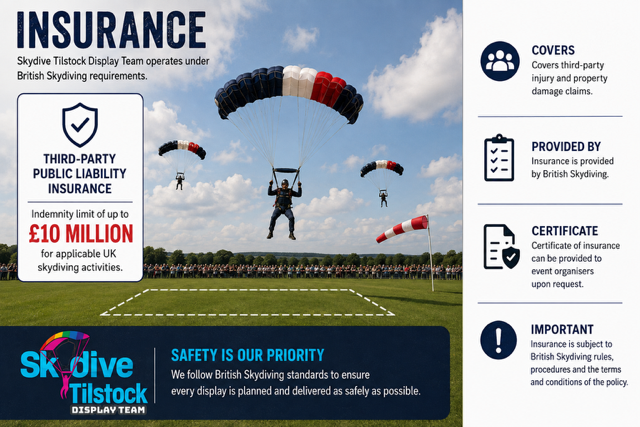
Skydive Tilstock Display Team operates under British Skydiving requirements.

British Skydiving provides third-party public liability insurance with an indemnity limit of up to £10 million for applicable UK skydiving activities.

Evidence of insurance can be provided to event organisers where required.
Don’t worry – send us the location and we will take a look. We can assess the proposed landing area, surrounding hazards, airspace, access and other operational considerations and advise whether a parachute display is feasible.

Safety first

Safety is at the heart of every display undertaken by the Skydive Tilstock Display Team. Display parachuting places skydivers into locations that are very different from a normal parachute drop zone, often with spectators, restricted landing areas and additional hazards. For this reason, every display is individually planned, assessed and managed.


From the initial site assessment through to the final jump, we work with event organisers to protect our parachutists, ground crew, event staff and members of the public. Our displays are planned and conducted in accordance with British Skydiving requirements, with the final decision to proceed always based on the conditions and circumstances on the day. 

Our parachutists are qualified members of British Skydiving and operate within the requirements of the British Skydiving Operations Manual.

British Skydiving Registered Display Teams operate under defined procedures covering qualifications, equipment, currency, landing areas and the planning and conduct of parachute displays.

Display parachuting requires additional experience and qualifications beyond those required for normal sport parachuting.

Team members are selected according to their British Skydiving Display Rating, experience and the classification and size of the proposed landing area.

British Skydiving also requires display parachutists to maintain specific levels of recent jumping experience. Our Display Team Leader checks the qualifications and currency of team members before each display.

British Skydiving membership includes third-party legal liability insurance for applicable skydiving activities.

The current indemnity limit is £10 million at British Skydiving Affiliated Parachute Training Organisations, with British Skydiving’s insurance arrangements also specifically recognising organised and notified displays conducted by British Skydiving Registered Display Teams.

Evidence of insurance can be supplied to event organisers where required.

Every display location is assessed before the event.

British Skydiving requires the proposed Parachute Landing Area to be visited and reconnoitred by an experienced team member, with existing and anticipated hazards identified.

Our assessment considers the landing area, surrounding obstacles and hazards, spectator areas, access, airspace, aircraft operations and emergency arrangements.

Conditions are continually reviewed and the assessment can be updated if circumstances change.

A successful display starts well before the aircraft takes off.

We liaise with event organisers regarding the proposed landing area, display timings, spectator management, access, communications and emergency arrangements.

The required aviation notifications and permissions are dealt with as part of the planning process, including the relevant British Skydiving, CAA and airspace notification procedures where applicable.

Written permission for use of the landing area is also obtained as required.

Weather is monitored before and throughout the display operation.

Wind speed and direction, cloud base, visibility and other relevant weather conditions are considered when deciding whether a display can proceed safely.

The Display Team Leader may impose operating limits below the maximum permitted limits where the landing area, turbulence, wind direction, surrounding hazards or other conditions make this appropriate.

The final decision to jump always rests with the Display Team Leader.

Every display is supported by a specific operational briefing.

Parachutists and relevant ground crew are briefed on the landing area, identified hazards, exit and opening considerations, weather, communications, crowd considerations and emergency procedures.

The briefing ensures everyone involved understands the plan and their responsibilities before the display begins.

Our ground crew are an important part of every display.

They assist with management of the landing area, communications, liaison with the event organiser and monitoring conditions on the ground.

They also provide the Display Team Leader and parachutists with essential information immediately before the display and help maintain a safe landing area while the display is taking place.

Every display is different. That’s why we don’t simply arrive and jump. 

We assess the location, identify the hazards, check the airspace, monitor the weather, brief the team and continually review whether conditions remain suitable.

If we are not satisfied that a display can be conducted safely, we don’t jump.